

Fun Fact Collection


Vendor: 95
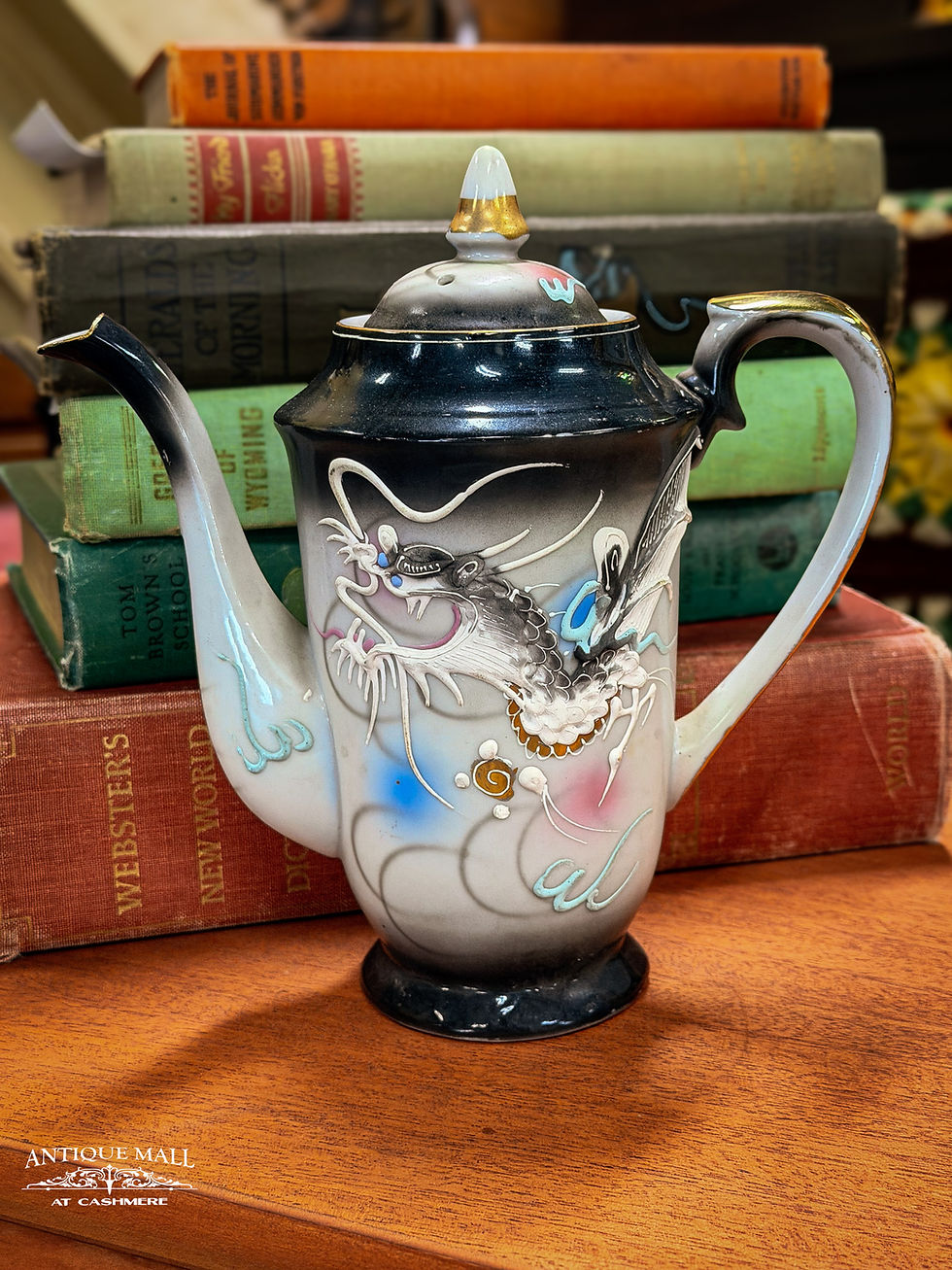
Vendor: 95

Vendor: 95
Vendor: 95
Dragonware
Have you ever had tea with a dragon?
Known today as Dragonware, these dramatic ceramics were made in Japan for the export market beginning in the late 1800s. Their defining feature was, of course, the dragon, often twisting through clouds or flames across teapots, cups, saucers, vases and other pieces.
What really made them stand out was their three-dimensional decoration. The dragons were often created using moriage, a technique that built raised decoration on the surface of the porcelain. Earlier examples could be incredibly elaborate, with dragons wrapping around an entire piece, detailed scales, gilding and even tiny glass beads for eyes. As the 20th century progressed, the designs generally became simpler and the dragons smaller.
But some Dragonware cups have another surprise hiding inside.
Hold one up to the light and you may suddenly see the face of a woman appear in the bottom of the cup. These images, commonly called geisha lithophanes, aren’t painted on. The portrait is molded into the porcelain in different thicknesses so that light passing through it creates the image. They are most often found on Japanese export cups dating from the late 1930s through the 1950s and into the early 1960s.
Not every Dragonware cup has one, which makes finding a hidden face all the more fun.
So the next time you spot an old Japanese cup covered in raised dragons, don’t just admire the outside.
Hold it up to the light. There may be someone waiting inside.